
Pedestrian districts, downtown areas, private parking facilities, and high-security sites increasingly rely on retractable bollards to regulate vehicle access. When paired with an LPR camera, these barriers become part of a fully automated, intelligent, and contactless access control system.
In this article, we explain how this combination works, the use cases it supports, and why it is becoming a key component of modern smart-city and secure-access projects.
What is a rectractable bollard?
A retractable bollard is a reinforced metal post installed directly into the roadway. Depending on the model, it can be raised or lowered manually, semi-automatically, or automatically to allow or restrict vehicle access to a designated area. Retractable bollards are commonly used in pedestrianized downtown districts, private parking facilities, government sites, secured residential communities, airports, industrial facilities, and other controlled-access environments.
Their primary role is to protect people and property. By preventing unauthorized vehicles from entering a controlled perimeter, they help reduce the risk of intrusions, hostile vehicle attacks, and accidents between vehicles and pedestrians. They also support broader environmental goals. By limiting traffic in selected areas and encouraging pedestrian-friendly urban planning, retractable bollards can help reduce noise, congestion, and vehicle-related emissions. Some models are even designed to operate with solar power, further reducing their environmental footprint.
On its own, however, a bollard usually requires human intervention or a credential such as a key, badge, code, remote control, or intercom. When connected to an LPR system, it becomes a fully automated vehicle access control solution based on license plate recognition.
What are the main types of rectractable bollard?
Retractable bollards generally fall into three categories, depending on traffic volume, operating frequency, and the level of automation required.
Manual retractable bollards: Raised and lowered using a key, handle, or lever, manual bollards are simple to install and cost-effective. They are best suited to low-traffic areas such as small parking lots, private properties, and access points that are used only occasionally. Their main limitation is that every operation requires a person to be physically present.
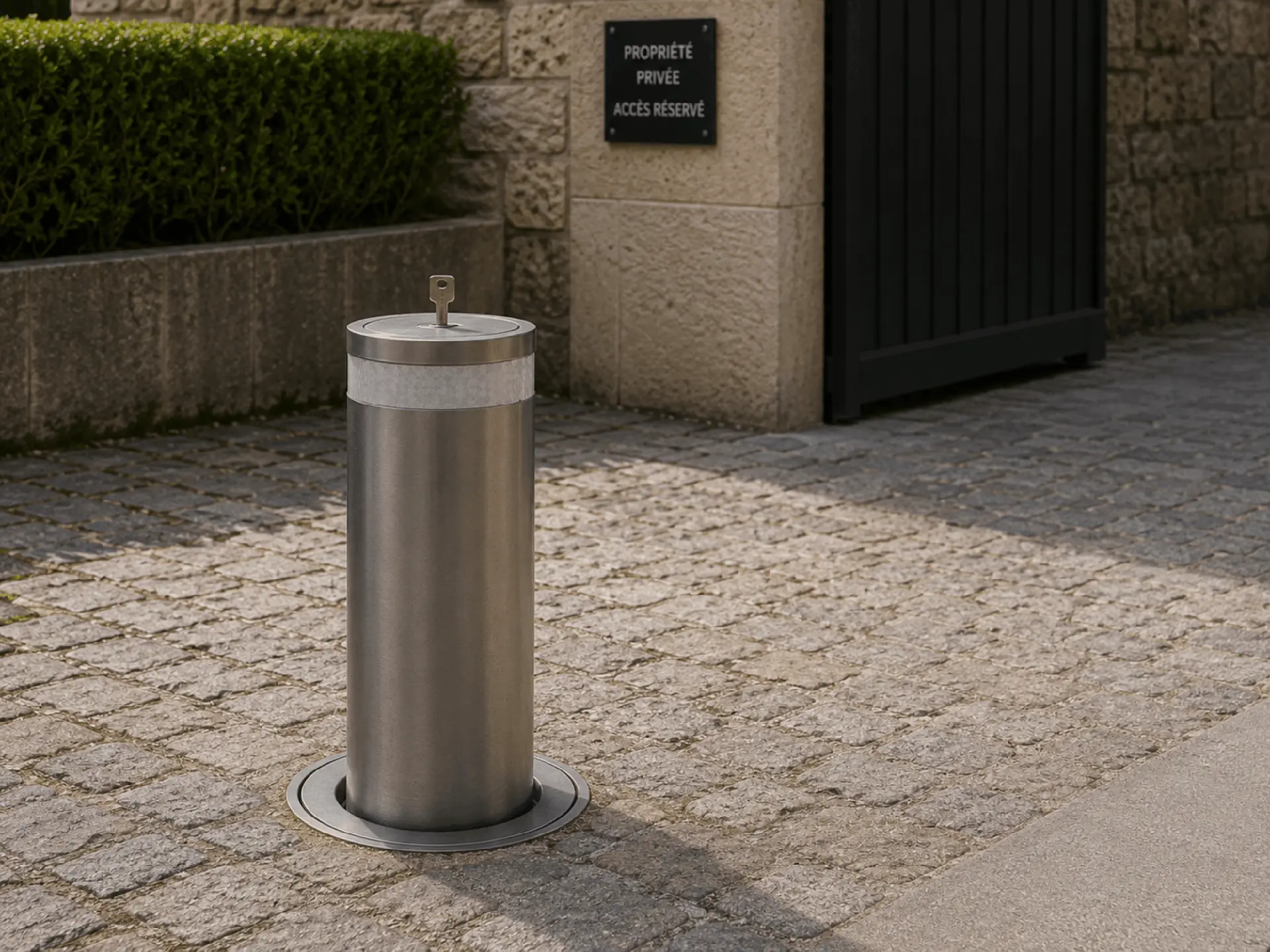
AI-generated image
Semi-automatic retractable bollards: These models use a hybrid operating method. Unlocking is performed manually, while a gas spring or assisted mechanism helps raise or lower the bollard. They are easier to operate than fully manual systems but still require human intervention. Semi-automatic bollards are typically used in residential communities, small parking facilities, and areas with moderate traffic.
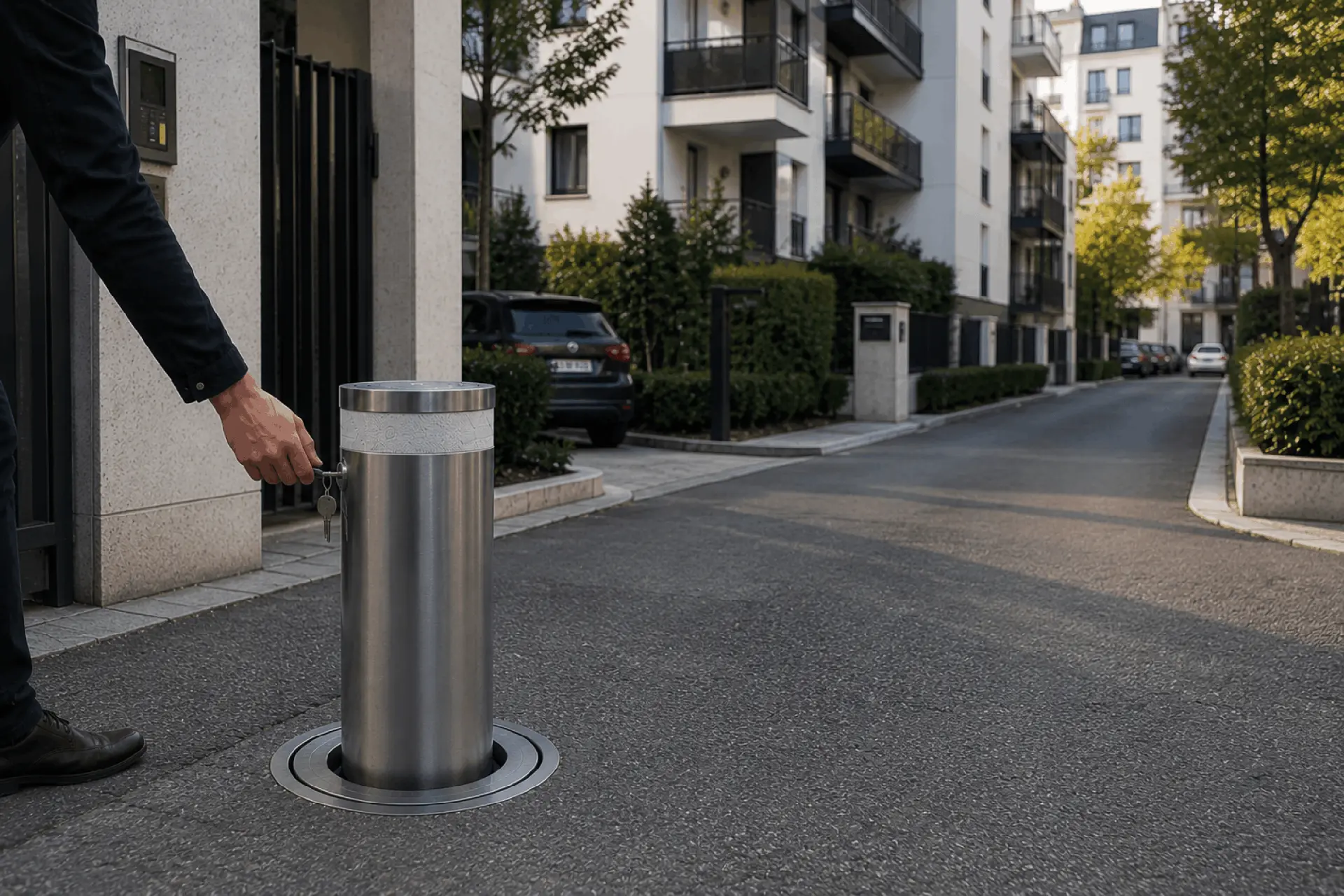
AI-generated image
Automatic retractable bollards: Automatic bollards are fully motorized and can be controlled remotely through a badge reader, intercom, access control software, security platform, or LPR system. They support centralized entry and exit management, continuous operation, and a high level of security. They are the preferred option for high-traffic and high-security sites, including city centers, airports, public parking facilities, government buildings, and pedestrian districts.
Key takeaway: For intelligent, automated vehicle access control, an automatic retractable bollard paired with an LPR camera offers the most capable and seamless solution. |

Photo taken on the Paris waterfront showing a rectratable bollard equipped with Survision's LPR camera.
Where are rectratable bollard most valuable?
- Protecting pedestrian areas: Cities across Europe - including Paris, Barcelona, Brussels, and Marseille - have expanded pedestrian-only and limited-access districts. Retractable bollards help strictly control which vehicles may enter, such as residents, delivery vehicles, public service vehicles, and emergency responders. They also provide a physical deterrent against forced-entry incidents and vehicle-ramming attacks.
- Regulating vehicle access: Bollards can filter vehicles according to precise criteria, including authorized hours, vehicle category, pre-registered license plates, delivery windows, resident status, or environmental-zone requirements. Access rules can be updated in real time by the site operator.
- Managing traffic around parking facilities and sensitive sites: Private parking facilities, industrial sites, airports, and government buildings use bollards to reduce queues, improve traffic flow, and prevent unauthorized entry around the clock.
- Preventing unauthorized parking: In regulated areas, retractable bollards reserve access and parking for approved users such as residents, merchants, service providers, or delivery operators. They reduce illegal parking without requiring continuous on-site enforcement and are especially valuable in historic and tourism-heavy districts.
Why pair rectratable bollards with LPR cameras?
Integrating an LPR camera turns a retractable bollard into an intelligent access control device. It removes the need for badges, access codes, remote controls, or other credentials that can be lost, forgotten, duplicated, or shared. It also eliminates routine interaction by drivers and enables autonomous operation 24/7.
For bollard manufacturers and integrators, adding LPR provides significant product value. It expands the system from a physical barrier into a premium automated access solution, helps address public-sector and smart-city requirements, and creates new opportunities in high-security and high-traffic applications.
For municipalities and site operators, the result is a smoother user experience, stronger access control, better auditability, and centralized management of vehicle permissions.
How Does the System Work?
- The vehicle approaches the access point.
- The LPR camera instantly captures and reads the license plate.
- The system checks the plate against the authorization rules stored in the database.
- If the vehicle is authorized, the bollard lowers automatically.
- The vehicle passage is recorded with a date and time stamp.
The entire process takes only a few seconds. There is no prolonged stop, no physical contact, and no need for the driver to present a credential or interact with personnel.
Comparison: retractable bollard with and without LPR
Criterion |
Bollard without LPR
|
Bollard with LPR
|
|
Access method |
Badge, code, key, intercom, or remote control required | Automatic license plate recognition |
Security | Credentials may be lost, forgotten, duplicated, or shared | Access is tied to a unique, authorized vehicle plate |
Traffic flow | Vehicles often need to stop, which can create delays | Immediate authorization supports smoother traffic flow |
Passage records | History may be available through badge or controller logs | Centralized, real-time vehicle passage history |
Authorization management | Often local or manually managed | Remote management through a centralized platform |
User experience | Driver action is required | Touchless, hands-free access |
Real-World example: The Seine riverbanks in Paris
Along the Seine riverbanks in Paris, automatic retractable bollards equipped with SURVISION LPR cameras regulate vehicle access to areas that are heavily used by pedestrians. The system automatically identifies authorized vehicles and lowers the bollard without requiring a badge, code, or on-site operator. This deployment illustrates how LPR can be integrated directly into urban access infrastructure to protect pedestrian spaces while preserving controlled access for approved vehicles.

Access control using automatic retractable barriers that read license plates along the banks of the Seine (Paris, France)
Conclusion
Combining an automatic retractable bollard with an LPR camera creates a vehicle access control solution that is smoother, smarter, and more secure. It improves traffic flow, reduces user friction, centralizes authorization management, and strengthens control over every vehicle entering the site. For smart cities, secure facilities, parking operators, and access control integrators, this combination has become one of the most effective approaches to automated vehicle access management.
Planning a retractable bollard installation or an automated vehicle access project? Learn more about SURVISION PlateAccess or contact one of our experts at sales@survisiongroup.com.